Plan-Spec: Teaching Agents to Think Before They Code
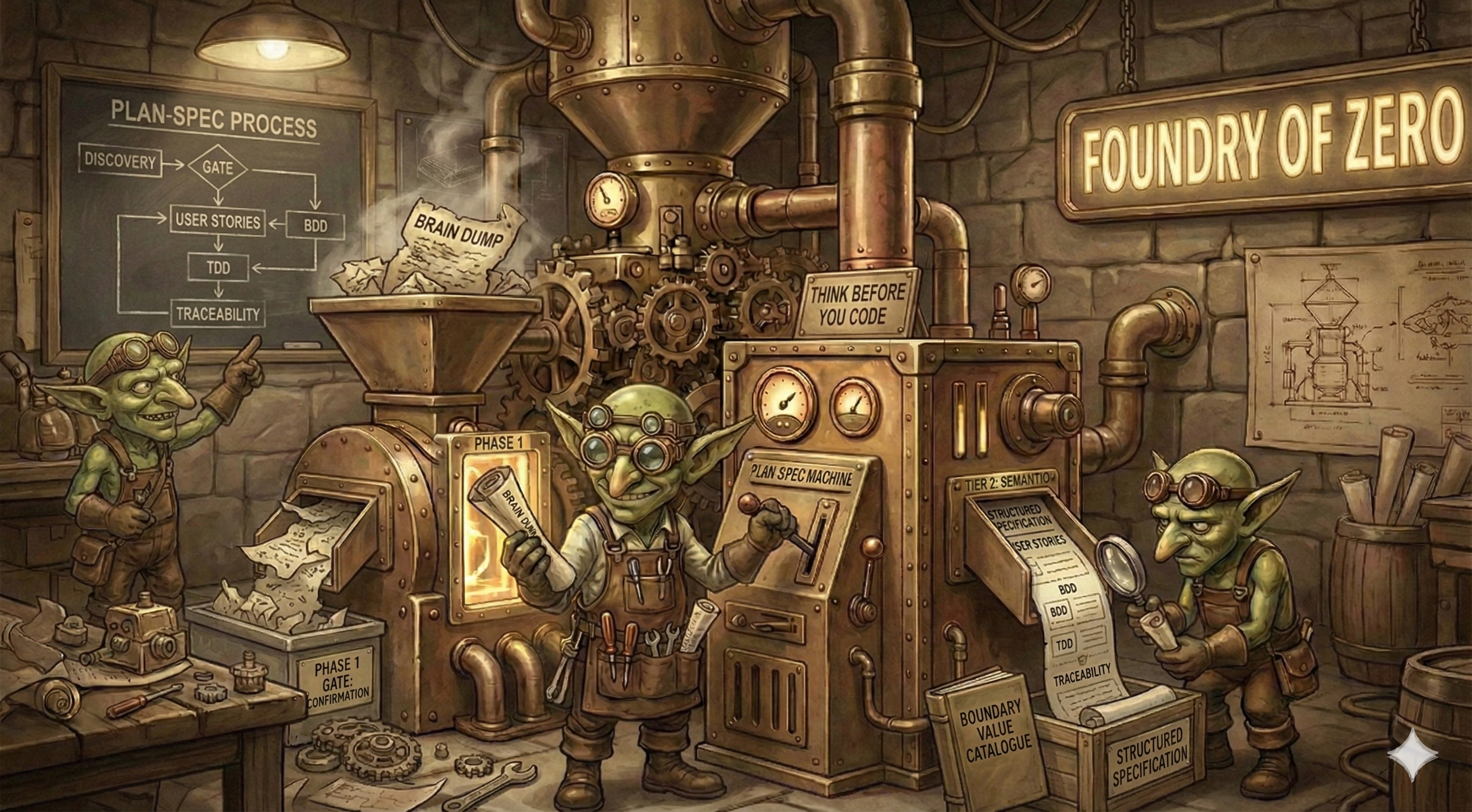
A good specification answers four questions: what are we building, how do we know it works, what happens when it doesn’t, and where does each requirement trace to? Most AI-generated plans answer the first question enthusiastically and hand-wave the other three.
The problem isn’t that the agent can’t think. The problem is that nobody told it how to think systematically.
This matters because specifications are contracts. When an agent builds from a spec that says “user can reset their password” with no acceptance criteria, no boundary conditions, and no test plan, the agent fills the gaps itself.
So Opus and I built a skill that forces the thinking to happen before the first line of code exists.
How it works
Plan-Spec is a Claude Code skill – Markdown files in .claude/skills/plan-spec/ that teach the agent a structured process for producing specifications. No runtime code. No dependencies. About 1,145 lines of carefully structured instructions across six files.
/plan-spec "Add OAuth2 support with Google and GitHub providers"
The agent walks through six phases, starting with discovery. It asks clarifying questions about actors, scope, constraints, and priority, summarises what it heard, and waits for confirmation. There is a hard gate:
GATE: Do NOT proceed past Phase 1 until the user explicitly confirms the captured requirements are correct.
This is the phase that earns its keep. The gate prevents Claude from doing what LLMs love to do: autocomplete the entire spec without checking whether it’s autocompleting in the right direction.
Once confirmed, the agent works through user stories with prioritised acceptance criteria, BDD scenarios in Given-When-Then format, a TDD plan with tests ordered by dependency, functional requirements using RFC-2119 language (MUST/SHOULD/MAY), and measurable success criteria. Everything gets assembled into a single Markdown file.
Traceability
Plan-Spec’s central obsession is that every artefact links to the artefact above it and below it:
Functional Requirement → User Story → BDD Scenario → Test Name
      FR-003           →   US-2     →  Scenario 2.3 → test_expired_token_rejected
Every BDD scenario carries a Traces to: line referencing its parent story. Every test maps back to a scenario. Before finishing, the agent runs a checklist: every user story has acceptance scenarios, every scenario has BDD coverage, every BDD scenario maps to a test, every functional requirement appears in the traceability matrix, and every success criterion uses measurable language. “Works correctly” gets rejected. “100% of expired tokens rejected” does not.
The boundary value catalogue
The skill includes a 201-line reference catalogue of boundary conditions organised by input type. Numeric: zero, min-1, max+1, 0.1 + 0.2, NaN. Strings: empty, null, max+1, unicode combining characters, <script>alert(1)</script>, emoji. Dates: leap year February 29th, DST transitions, 9999-12-31. Plus categories for concurrency, state corruption, network failures, and resource exhaustion.
The agent consults this for every feature. It doesn’t need to remember that non-leap-year February 29th is a meaningful test case – it’s in the catalogue.
What it produces
A spec for a password reset feature comes out at 366 lines. Three user stories, eleven BDD scenarios, seventeen ordered tests, twenty-seven test data rows across three datasets, ten functional requirements, six success criteria with numeric thresholds, and a complete traceability matrix. The chain runs unbroken from “why are we building this” to “how do we know it’s done.”
It’s a skill, not a compiler – there’s no deterministic guarantee that two runs produce identical output. But the structure is consistent, the traceability checks are systematic, and the output is miles ahead of “here’s a plan with some bullet points.”
How it fits with Taskify
Plan-Spec operates upstream of Taskify. Plan-Spec answers “what should we build and how do we test it.” Taskify answers “is the task description well-formed enough for an agent to execute,” and validates it deterministically against a JSON Schema. You’d use Plan-Spec on Monday to think through the feature, then Taskify on Tuesday to break it into validated, tracked work items.
The meta-point
Every specification problem is a thinking problem. The agent didn’t produce a vague spec because it’s incapable of precision – it produced a vague spec because you asked for a plan and a plan is whatever the agent thinks a plan looks like. Give it a structured process with mandatory traceability, boundary value catalogues, and an explicit gate between discovery and design, and it produces something you’d actually build from.
The fix isn’t a smarter model. The fix is a better process – and the process fits in six Markdown files.